Archive for the 'Entertainment' Category

How To Get A Free Roller Coaster Photo At Six Flags or Disney World

Thursday, July 17th, 2008

Cheapskate, Appropriately Frugal, or Brilliantly Simple? You Decide

Well we’ve finally reached the dog days of summer - the hottest stretch of heat sweltering days of July and August. For those of you who live in colder climates, bless your hearts - enjoy the mild temperatures while you can because colder weather will be upon you soon. But for everyone else who lives in a state or region that enjoys four seasons year round with hot and humid summers like I do, it’s time for all of us to get outside and enjoy that nice sunshine warmth.

One of the best ways to get some mild exercise, and enjoy the great outdoors with the family at the same time is to visit an amusement theme park like Six Flags, Busch Gardens, or Disney World. Now you might be thinking to yourself - wait, visiting an amusement isn’t exercise and it sure isn’t the great outdoors. Where is the huffing and puffing, and where are the essential greenery that make up the great outdoors? I guess that’s where you and I differ - I consider the great outdoors to be anywhere that’s not cooped up inside an air conditioned house or apartment on a summer’s day spent watching TV or playing Nintendo Wii. As long as you are out and about, walking around outside, enjoying the sun’s natural Vitamin-D inducing rays, you are immersed in the great outdoors my friend.

In addition, all that walking around, waiting in line, and strolling from roller coaster ride to concession stand is definitely exercise. It’s not exactly running an Olympic marathon, but you’ll likely burn off some needed calories in the process. The last time I went to Six Flags, my poor puppies (my weird slang for feet) ached after walking around all day. I visited the amusement theme park during pre-season so the lines were incredibly short and non existent, prompting me and my travel companion to walk around even faster to ensure we hit every single roller coaster ride and gaming stand by day’s end. It was a fun, but rather tiring and dizzying experience.

You’re Getting Off Track Again - What About The Free Roller Coaster Photos?

Now, anyone who has ever been to one knows that spending a day at the amusement park does not come cheap. In fact, most places are pretty expensive and if you’re not careful about your budget or keep a tight reign on careless spending on snacks and drinks, you mind find yourself blowing more money than expected - just like you do at the movies. At amusement theme parks like Six Flags, you can expect to shell out anywhere from $25 to $50 per person depending on your age and height, and even more on top of that for meals and other gaming experiences. At mega theme parks like Orlando Florida’s Disney World resorts, tickets range anywhere from $70 for young children to more than $160 for adults for multi-park access. Thus, any little thing you can do to cut costs here and there will help you save lots of money in the long run and prevent you from losing your financial mind.

Here’s a little tip I picked up a while back on how to get free roller coaster photographs of yourself and free on-board pictures of your friends at any amusement theme park. After every major roller coaster ride, as you’re walking down the exit ramp rather dizzily from the experience, you’re likely to bump into the ubiquitous roller coaster souvenir photo booth. At the stand you’ll usually find a sales counter along with multiple television monitors mounted high up, cycling through live digital photo shots of roller coaster riders taken in various stages of facial displays ranging from joy and happiness, to sheer terror (but they are usually all funny). The images are all photos automatically taken by strategically mounted on-ride cameras located throughout the track. Oftentimes, the cameras are installed on segments where the riders experience the greatest speed, resulting in a variety of funny displays of wacky and distorted expressions due to excitement, fear, or just plain wind resistance. Sometimes, all occupants of a single roller coaster car are displayed in one photograph, and sometimes only two or four people are displayed at one time. The photos on the display screen are usually numbered and park customers willing to purchase their own can do so. The instant photos are usually available immediately after the ride is over should you choose to buy them - and they frequently come in a variety of specialty trinket forms like T-shirts and key chains. The prices charged however, are frequently expensive rip off prices. A tiny wallet size photo may cost in excess of $15-20 each. Larger photos may be priced as high as $25-$35 each. Keychains and T shirts can easily cost in excess of $25-$45.

For those who want to get their roller coaster photos for free, you’ll have to act fast as soon as the ride is over. Usually the rollercoaster souvenir booth video displays cycle through the most recent ride results from one car to another before moving on to the next set of new vehicle riders. As guests exit the ride, the display screens update the photos with the latest riders, thereby gradually burying the photos of riders that came before. If you want to save some money, take the limited time opportunity to raise up your digital camera, zoom in, and take a direct digital photograph of the display screen when your rollercoaster shot cycles through. You’ll want to act fast as your photo will likely only be flipped through a few times before disappearing for good. If you’re quick, you just might be able to walk away with a high quality, free roller coaster self shot.

The last time I was at Six Flags, I did just that for numerous rides. It sort of baffled me at the time why no one else was doing it though. As soon as I saw the screen display of my friend and I, I raised my Canon Digital Elph sky high to rise above the crowd of riders waiting to buy souvenir photos, and quickly snapped off a few free shots. As soon as I did that, everyone looked at me with eyes widened, and immediately took out their own cameras to do the same - frantically snapping their own self pics as the display screens flipped to images of them. Such frugal tips seem so common-sensical that we oftentimes fail to realize that we can easily get many things for free just by trying.

Financially or Morally Ethical? It’s Up To You - But Remember, You Did Pay The Price Of Your Pricey Admissions Ticket

While I doubt Six Flags, Disney World, Disney Land, Kings Dominion, Busch Gardens, or Cedar Point officials condone this type of free photograph taking, I’ve never noticed any signs or ticket stub fine print restricting this frugal (albeit freeloading) practice. Support the park and pay your $35 roller coaster souvenir photo at Kingda Ka or any other popular ride if you want. However, in my opinion, you’ve already paid for your price of amusement park admission, so you might as well maximize your budget by taking advantage of free photographing opportunities. Once you snap a photo with your digital camera, you can pretty much make as many digital prints as you want.

I suppose the lawyer part of me feels compelled to address one more concern. As for questions about copyright infringement legalities, don’t worry. Copyright laws only protect the rights of actual tangible mediums of expression whether it be an expression of writing, photography, or music. Yes it would be a possible copyright violation if you were to copy the digital photographs off of the souvenir booth computers directly and reproduce them (that might be considered criminal theft as well). But by using your own personal digital camera to take a photograph of the monitor indirectly, you are in the clear. Feel free to snap away. You are now your own paparazzi!

Even Celebrities Can Fall On Hard Times And Face Home Foreclosure

Sunday, June 8th, 2008

When you think of Ed McMahon, you don’t exactly associate or lump him with big time wasteful spenders like MC Hammer and some of the other well known celebrities of the past who rose to fame and fortune quickly but ultimately frittered away their money into bankruptcy on trivial pursuits. No, when you think of Ed McMahon, you think of the aging but charismatic late night show announcer, the TV personality, and the face and voice of the American Family Publishing sweepstakes team (not to be confused with the more popular Publisher’s Clearing House sweepstakes) that arrives unannounced at the homes of winners to present them their grand prize. You certainly don’t see or hear about him throwing his money away on fast cars, fast women, or holding lavish sleaze parties to great excess.

So I was quite surprised when I learned that someone like the now 80 plus year old Ed McMahon has now found himself in difficult financial straits and faced with the prospect of mortgage foreclosure on his multi million dollar home. This housing bubble and credit crisis seems to be quite merciless and universally brutal, even to those who simply lived their lives with the best intentions, but still succumbed to hard times. With little regard to feelings or reason, the mortgage credit crisis and the powerful forces of housing supply and demand have devastated many good families.

Ed McMahon and His Wife Pam Speak Out About Home Foreclosure and The Possibility Of Losing Their House

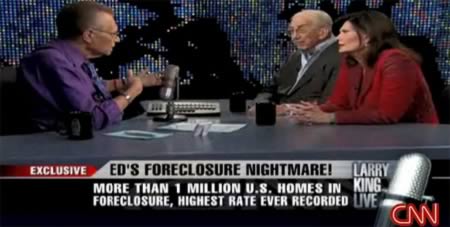
Ed McMahon recently appeared on the CNN Larry King Live show (CNN video clip) with his wife to discuss their difficult foreclosure nightmare and explain how a former multi-millionaire such as himself could fall from financial grace after all these years and have his house foreclosed on. During the conversational interview with Larry King, many of Ed’s words about how it all happened rang true:

“If you spend more money than you make, you know what happens. A couple of divorces flown in - a few things happened. You want everything to be perfect, but that combination - the economy, a little injury, breaking my neck - you just can’t work with this thing around your neck.”

“In some sense, I want to speak for the million people who now have foreclosure signs on their houses. I just want to give them hope, give them optimism and some guidance. Get the best corrective people you need around you, keep working at it, don’t stop. There’s a lot of people who are hard workers, did everything right, didn’t do anything wrong, and all of a sudden they are in this boat, and I speak for all of them as far as I’m concerned.”

“For everyone out there who’s going through this, we really sympathize with you. Be optimistic. It can be done. All kinds of things can happen. Let it work out great for you.”

When asked by Larry King to comment on the public assumption that the McMahons are multi millionaires and asked how they could have fallen behind $644,000 on their house mortgage payments, McMahon’s current wife Pam chimed in (tearfully at times):

“People do assume that you have hundreds of millions of dollars, and I think over the years it’s a combination of Ed working so hard and not looking at proper management which happens a lot. Because you’re a celebrity, people think you have a lot more than you have. And you always want to take great care of all your friends and family in all you do. We didn’t keep our eye on the ball and we made mistakes.”

“But you have to not give up. Whether we keep our house or we don’t keep our house. The whole financial issue might be the thing that ruins marriages, ruins relationships - but our marriage is strong.”

“You have got to realize that you can get through it. You never know what good things can happen for you tomorrow. Keep the faith.”

My Thoughts On Upper Class Celebrities, Ordinary Middle-Class Americans, and How To Protect Oneself From The Realities Of The Recessive Economy and Housing Market

After listening to the interview, I have to say I really started to sympathize with the plight of those in foreclosure. I know Ed McMahon and his wife Pam aren’t exactly representative of the classic foreclosure case, but at least they can relate to the pains of someone who can no longer afford his or her home mortgage loan payment and compelled to face the reality of home foreclosure. It’s an embarrassing and even humiliating experience that no one wants to be forced into. Home ownership is the American dream and when you can’t afford your pride and joy any longer, it’s a tough pill to take.

As I am currently still a happy renter and have not yet become a home owner, it is in my own personal and financial interest to see that there is no housing bailout whatsoever instituted by the government. This would obviously be the most self centered and self motivated route to take as opposition to any housing foreclosure bailout or assistance would help to ensure a growth in the glut and oversupply of available homes on the market, thereby substantially driving down real estate prices for the next 2-3 years until I decide to finally enter the housing market as a buyer.

But I do sympathize with most of the owners of the more than 1 million American homes (CNN news article) that are now shockingly finding themselves in foreclosure jeopardy. Sometimes in life, you do everything right with good intentions and yet bad things still happen when you least expect it. In Ed McMahon’s case, he may have lived an early life of entertainment and celebrity success and held to great esteem in his work, earning millions of dollars through the process, but apparently he failed to adequately plan for the future and prepare himself for inevitable financial emergencies.

The reality of home ownership life is that even those with good Fico credit scores who are able to qualify for and obtain prime fixed rate loans on their houses, bad things still may happen. Sometimes through no intentional fault of their own, people lose jobs, divorces happen, child custody battles rage on, or injuries and illnesses come up making one unable to afford one’s house anymore. With a stagnating economy in recession and plummeting real estate market prices eliminating much of the home equity built up in homes, such drastic and hard financial times can hit the best of folks. Without a proper emergency fund or savings set aside to handle such occurrences, even millionaires and celebrities, let alone ordinary people like you and I, can get hit by troublesome cash flow crunches.

The solution I think is to know and realize early on that life is inherently unpredictable and fraught with financial peril. Like the stock market, no one can accurately predict the good and the bad that will happen in the future. We can only anticipate and plan for the worst but hope for the best. While there are basic financial planning steps to take, such as investing for retirement through tax deferred vehicles like a Roth IRA account, one of the most important decisions is to save and build up an emergency fund. The amount that you will need to set aside for emergencies will vary from person to person, but it’s important to plan for emergencies. For example, my car recently broke down and I had to face a sudden and emergency $1,200 auto service repair bill to replace my vehicle’s alternator and battery to get it working again. Fortunately, I had saved enough on the side to handle such an emergency occurrence and expense.

The other important thing that we should glean from the Larry King - Ed McMahon interview is to stay optimistic and keep fighting. Never give up in despair. For those who are mired in housing foreclosure, credit card debt, or even perpetual unemployment, there is light at the end of the tunnel. Don’t forget, there are many similarly situated people out there trying to stay financially afloat just like you. Just keep plugging through and maintain the faith.

Internet Service Is More Important To Me Than Phone or Cable TV

Friday, June 6th, 2008

These past few weeks have been tough on me. Not only did my trusty Honda Accord suddenly break down, but I’ve been experiencing major Internet service disruptions at home caused by the incompetence and admitted overselling activities of my current broadband service provider Comcast. For months now, I’ve been plagued by frequent Internet outages coupled with agonizingly slow download speeds reminiscent of my old 56k screech-and-hiss modem days. The breaks in service finally culminated into the complete stoppage and loss of my home Internet signal. Furthermore, the service disruption repair activities were hampered by a series of powerful thunderstorm waves that swept through my area this week, knocking out electricity, cable TV, and broadband Internet service for almost all seven days. While my car was washed and scrubbed sparkling clean by the rain and wind, lightening sparks managed to knock out the power in my neighborhood. Electricity was “quickly” reactivated in 1-2 days, but cable TV and my precious broadband Internet service wasn’t repaired and fully restored until nearly a week thereafter.

For the last few days I’ve been a pretty sad fellow. Not only did I feel isolated and cut off from the real world without convenient home access to the Internet, I haven’t been able to properly update my personal finance blog, nor have I been able to check my email messages, or tend to the operations of any of my online passive income businesses. On a normal weekday I usually receive close to 50 emails a day from a variety of personal and business related sources. By the time my Internet service was finally restored, I was greatly backlogged and had major catching up to do.

I Never Realized How Much I Relied and Depended On Having Home Based Internet Access, Until It Was Suddenly Taken Away From Me

I used to feel this way about TV, but I now have a new love - my computer (and the Internet service it provides me). When my precious Internet is gone, I feel crippled. This is not the first time I’ve experienced an Internet outage due to loss of power, but it’s the first time I realized how much I depended on my broadband Internet service at home. In the past, whenever my cable Internet service was knocked out, I’d simply access my backup laptop’s wireless signal manager and search for one of my random neighbor’s unsecured wireless signal to piggy back off of. Oftentimes I would get lucky and find one subscribed to a different broadband Internet provider that still had active service. While the majority of the stray wireless signals were properly password protected, a few were left publicly accessible. However, as the importance of securing one’s wireless router from unwanted intrusion has picked up steam, I find that most signals today are properly secured and inaccessible to strangers like myself. Particularly in a condo complex such as mine that’s populated by mostly tech savvy young adults and families, finding an unsecured wireless signal to temporarily piggy back off of is proving more difficult nowadays.

Since I’ve been working from home for the last few months, I’m not able to access the web through an alternate location such as an office workspace. So for the last few days during the outage, I visited my local library to get my Internet fix and to keep tabs on my email messages the best I could. Due to usage limits of an hour per day on the computers at my public county library, I wasn’t able to fully respond to all messages during each sitting and frequently had to do the bare minimum when it came to managing my online finances and keeping track of all my wheelings and dealings. Since I’ve adopted the practice of going all electronic and paperless and have converted all my paper bills into e-billing and automatic debit payments, not having immediate home based access to the Internet puts me in an incredibly inconvenient position. It’s a hopeless and powerless feeling when you’re unable to properly manage and access important aspects of one’s personal and financial life in real time. Especially since I am currently managing a major balance transfer credit card arbitrage, not having online account access makes it difficult for me to keep tabs on monthly due dates and stay on top of my minimum payments. If I’m not careful with online due dates, I could easily unintentionally commit a tragic balance transfer mistake and ultimately face terrible repercussions. It’s been so long since I’ve performed paper or phone banking that I’m not even sure how it’s done anymore exactly or where to locate my backup paperwork. I’m simply so used to doing everything online these days.

We’ve Become An Extremely Technology and Internet Dependent Generation

The no-Internet experience left me amazed and somewhat alarmed at how much my life has grown so reliant on the availability of the Internet. While it’s only a single form of technology, it’s a mode of communication and source of information that I’ve become extremely dependent upon. It’s interesting how only about a decade ago, no one had even heard of Google, Yahoo, Mapquest, or CNN.com. Back in the Internet-less caveman days of the early 90’s, we relied on non electronic forms of communication and information gathering. Before the Internet, people relied on daily newspaper deliveries for their written news, people purchased hard compact discs for their music, paper maps were used to plot directions, and people actually obtained background information on a variety of common topics by turning to hardcover encyclopedias.

Today, people rely on CNN.com, NYTimes.com, Yahoo news, and even online blogs to get their daily news. People order songs individually from online vendors like iTunes. People use online websites like Mapquest or Google maps, or utilize handheld GPS devices to easily and automatically get directions to where they want to go. Nowadays, the old volumes of encyclopedias have become extinct as all forms of text and multimedia data have been compiled and stored onto easy to carry around storage disks, or have been uploaded onto online information repositories like Wikipedia. As a testament to its breadth, the Internet is even changing the way we order pizzas now. Today, the trend of ordering freshly made pizzas online in real time through vendors such as Papa John’s is growing rapidly. The Internet has essentially phased out the clutter generated by paper documents, menus, and voluminous booklets.

The Internet Is Replacing The Cell Phone and Cable TV As The Technology We Can Least Afford To Do Without

But with this great reliance comes the dangers as evidenced by how out of place I became as soon as this important technology was taken away from me. Today, with the Internet having enveloped and dominated our day to day lives, and high speed cable and DSL broadband having greatly expanded the media content we can now receive, we can barely function now without this important service. I know I can’t.

Without full Internet access for the last week or so, I became handicapped and only partially functional. In fact, I dare to say that not having access to the Internet was astronomically worse than not having my mobile phone or even not having a fully functional cable TV service. Both cellular phone and television service can be easily replaced and compensated by the power of the web. There are easy ways to make local, national, and even international phone calls for free using a computer and the Internet, and I can easily communicate with my friends and family through instant messaging or via social networks such as Facebook or Myspace. There are also plenty of free online shared videos on YouTube and daily updated news videos on the major news network websites that can replace the lack of TV service. But there is simply no duplicate or substitute for a non working Internet.

The Internet is so pervasive, it’s hard to know what life would be like if it ever disappeared. It’s a wonderful and powerful tool that has changed the way we interact, communicate, and live our lives, but at the same time it makes us very technologically dependent and vulnerable. We are more susceptible to critical financial and societal collapses from computer viral outbreaks or electrical infrastructure disruptions than ever before. Some say it has made us as a society more distant and anonymous to each other, but I disagree. I think it’s greatly improved our lives and has allowed us to reach out and touch others in a way not possible before. We can only hope that technology can continue to defy the elements of mother nature (thunderstorms) and adequately keep up with this never ending appetite for electronic convenience and digital information. Such electrical and service outages as I experienced this week mustn’t happen again. I just can’t bear to be without Internet access for too long. Things just don’t seem to run right or smoothly when I am offline for extended periods of time.

Nigerian 419 Scams and Spam Emails Are Funny But They Make Me Paranoid

Thursday, May 8th, 2008

My online messaging routine was doing fine for a while. Every morning I would check my Yahoo e-mail account for messages, and then go about my regular work day, periodically checking back for personal and business related messages. Since I forward and consolidate all of my personal, work, and blog business related emails to one account with Yahoo, I have one easy point of access to my messages - essentially one well oiled emailing machine. Of course, there was always the occasional spam, but that was usually manageable - until now - until the Nigerians struck, and struck hard.

Spammers and Scammers Are Relentless And They Can Afford To Be - Sending E-Mail Lures With Scam Bait Doesn’t Cost A Thing

Starting very recently, I’ve been receiving nearly 20-30 spam related messages everyday. I have no idea how they are effectively evading my spam filters, but they are. These spam messages are driving me absolutely crazy and are irritating to say the least. But one can’t help but find some amusement from the content of these desperate messages. These spam letters that flood the web are mostly from the poor African country of Nigeria - sent by notorious computer users who run well documented Nigerian 419 scam operations. You know when you receive one of these classic Nigerian 419 spam letters as they are pretty recognizable. Usually the Nigerians use very flowery, British style English comprised of exaggerated legalese-type terminology to make the content appear more legitimate. However, oftentimes their lame use of the English language borders on comical and their complete lack of understanding regarding American and western male and female names makes me chuckle. For some reason they have a habit of using the funniest and oddest fake first and last names - using common first names as last names, and improperly matching up male and female names - like Peter John, Mark Donna, or Smith Karen for example - frequently it’s pretty obvious they’re fake names as the names simply sound unnatural. But then again, these Nigerians and African spammers are not incredibly bright. They may be criminally and diabolically clever, but they are not exactly all that well educated or worldly. They resort more to the law of probability and the long held truism that “a sucker’s born every minute”. By casting a very wide net, even their ill conceived attempts may net at least one or two potential biting fish in the long haul.

It’s not just the crazy Nigerians either, spammers and scammers live in other countries as well - all beyond the reasonable reach of established arms of law and justice. Most of them approach the spam and scam business utilizing the same typical shot gun approach. Since the Internet affords the ability to send out many messages at relatively little to no cost, they are able to send out massive amounts of spam emails to potential victims with one click of the mouse or a single tap of the keyboard. Perhaps 75% of their spam messages will be screened out by domain or email spam filters, and perhaps another 90% of those that don’t get filtered out are ultimately deleted by the recipients immediately. However, a small percentage will still get through and a small percentage will be read, and an even smaller percentage will ultimately fall for the scam bait. While the chances of an unwitting recipient acting acting upon the message and replying back to the Nigerian scammer are slim, some people still do.

Frankly, these scammers from Nigeria, Eastern Europe, and South East Asia have nothing to lose - the scams are usually quite profitable for them. Take the Nigerians for example - they live in a wasteland of a country - with a corrupt government, lax law enforcement, high unemployment, with little semblance of an economy. Any amount of money they can siphon from American citizens or that of other western countries is worth the effort and time. To them, there is simply very little risk involved since their government and police enforcement officials either turn a blind eye to their antics, don’t care, or are simply too financially overwhelmed to take on the challenge of cracking down on computer crimes.

Although I may have some sympathy for the poor economic lives the scammers must live in their native countries, their criminal attempts at trickery often leave me coldly and sarcastically insensitive. However, that doesn’t mean I can’t amuse myself with their lame shenanigans. That’s why I sometimes enjoy reading spam emails - they’re funny. They really amuse me - like something from the funny pages. Today I received an email from poor “Madam Ruth Moses” who addressed me as “dearly beloved in Christ”, stating that she was “suffering from a cancerous ailment” and that she was “married to Engineer Gilbert Moses an Englishman who is dead”. Apparently they lived a life of charity of helping the “down trodden and the less-privileged individuals”. Evidently she now has $4.4 million US dollars in some African bank due to a large financial payout stemming from her husband’s untimely death in a car accident that she is unable to retrieve, and is willing to give me a 25% cut if I assist by providing her a “small process charge” to help facilitate the release. Oh how generous and noble of Mrs. Moses - especially since she enjoys citing biblical passages in her message to me, for as she puts it “The Almighty will fight my case and I shall hold my peace.” Comical, yet pretty pathetic. If I ever had the chance to meet any of these spammers, I’d laugh at their face for 15 minute straight.

I Am Now Very Distrustful and Extremely Paranoid About Doing Business Or Any Online Communication With Residents From Proven Scam and Spam Prevalent Countries

Unfortunately, what scammers with their spam emails have done is made me very distrustful of anyone from traditional scam haven countries. The list of countries mainly stem from poor, and legally and socially undeveloped countries like Nigeria, Ukraine, Romania, Bulgaria, and Indonesia, but it also covers countries like Russia as well. Many of these third world countries either have corrupt governments or are constantly experiencing tribal warfare and upheaval that prevent stable law and judicial enforcement to flourish. But as of now, I would never do any online business with people who live in those countries at the present time. I’ve already been tricked once and after my one time experience of getting scammed during my post college years, I’ve learned my lesson. It may not be politically correct, but I think it’s a smart business move to refrain from doing any online or Internet transactions with anyone from these countries - the financial risks are simply too high. My purpose for rejecting individuals from these countries is not to stir up racial, ethnic, or even social controversy, but simply to protect my own financial interests, so please don’t take offense. I would gladly do business with them and so would millions of American merchants on eBay, Craigslist, and other online stores if only fraud wasn’t such a huge and rampant problem in those parts of the world.

I run a few small online eBay and weblog businesses (take a look at my ebay business guide), and these days the quickest way to turn me off and cause me to reject your business proposition right off the bat is to say you’re from Africa - it frankly doesn’t matter which country in Africa. I have yet to meet a single African country (aside from South Africa, although that’s debatable as well) that I trust to do business with. The rampant scams and spams that originate from that continent have turned me into a hyper-vigilant person. Most African countries simply have undeveloped legal systems that prevent merchants or publishers like myself from being able to bring legal action to effectuate contractual disputes. That is why the U.S. is such a great country. Despite our over-lawyered and lawsuit-happy society, we have a perfected legal system that ensures legal disputes have a forum to be heard and resolved. Scammers and spammers have a much more difficult time operating their illegal craft here in this country. A few foreign rotten apples have really ruined the whole international tree and apple pile, but online entrepreneurs like myself have to do to what it takes to protect ourselves and our interests. It may seem racist and prejudicial to rule out a whole segment of the world’s population, but it’s not - it’s just smart business.

Despite eBay’s attempts to provide it’s buyers and sellers with more purchase and selling protection, many if not most major eBay Power Sellers now refuse to ship to certain dangerous countries, such as Nigeria or Indonesia. A sizable number of merchants have even ruled out shipping to any foreign destination due to the prevalence of scammers living overseas where they are shielded from prosecution. It’s terrible what these online and Internet scammers have done to the whole industry. These days as I browse through business propositions and offers I receive over email on a regular basis, even African sounding surnames, African cities (like Lagos, scam capital of Nigeria), African banks, and anything to do with Africa trigger glaring red flags when I evaluate Internet commerce deals. So if your online business is based in Africa, I’m sorry, but I don’t want to do business with you at this time. Perhaps someday when your government stabilizes and sets up a legal system that will protect and ensure my legal and contractual interests I will consider it. But until then, too bad so sad. If you are a legitimate African, East European, or South East Asian business, don’t be offended if established western and far east Asian businesses demand strenuous proof of identity and extra evidence of trustworthiness before doing business with you.

All About The Nigerian 419 Advance Fee Fraud - Also Known As The Check Cashing Scam (For Those Not Familiar With What They Are)

The classic Nigerian 419 scam has been around for a long time but scam success didn’t fully take off until the advent of the Internet and the World Wide Web. The country of Nigeria has all the essential ingredients that has enabled it to become the worldwide hub of Internet and computer crimes. The country is not only dirt poor, but unemployment is incredibly high, and the government is hopelessly corrupt and incompetent. The country also happens to be an English speaking nation - making it all the more easier for select scammers to communicate with their primarily English speaking victims all over the world. The 419 numeric designation refers to the Nigerian Criminal Code that covers the crime of fraudulently obtaining property through false pretenses. Unfortunately the 419 criminal code is a mockery of the Nigerian legal and criminal enforcement system as the laws in that country are frequently ignored and flaunted, thereby allowing scammers and spammers to run rampant with little fear of accountability. The Nigerian 419 scams have recently developed into a world wide epidemic of Internet fraud crimes that have branched and spun off into other criminal areas such as: charity scams, romance scams, lottery scams, and even threats of violence and extortion scams.

In its most common form, the Nigerian 419 fraud is also known as the Nigerian advance fee scam. The process works by its ability to successfully build trust and emotional confidence with the alleged victim over time, and ultimately persuade him or her to provide confidential financial information or to send sums of money for the possibility of a much larger gain in return. The scam appeals to human greed and the fallible desire to inherently trust others. Through easy and unregulated access to Internet cafe computers and connections, Nigerian scammers have been able to harvest e-mail addresses and contact information to use in their elaborate scams. With potential victim contact information in hand, they usually submit massive amounts of electronic letters to recipients though deceptive means such as spoofed email letters, and cleverly disguised and graphically adorned emails that hide their malicious intent and true source. Oftentimes they’ll write and pretend to be a wealthy heiress or someone who is terminally ill and dying from a disease like cancer, and plead with the recipient for an amount of money in exchange for the promise that they will pay back the amount plus more. Oftentimes they will cleverly claim that they have access to or are in control of a vast financial fortune to which they would be willing to offer the recipient a huge portion as a reward if he or she would provide some upfront money first.

These scam letters are frequently very, very elaborate, as they often disguise the email meta headers to make them seem like they came from legitimate sources such as governmental agencies (like the classic IRS email scam letter for example). Sometimes the headers aren’t even disguised all that well, but the messages still contain content indicative of a mass spam campaign to artificially inflate the stock price of a particular financial investment (penny stock scam spam). Oftentimes they’ll make references to real life current events such as tragic disasters or make reference to official business developments such as laying claim to being connected with some wealthy foreign business developer in the news. Oftentimes they utilize fake phone numbers that can’t be tracked down. One common ploy of the advance fee scam is to send the recipient a fraudulent Western Union or fake personal check for a very large amount of money, and write to the recipient to apologize for the excess amount that was sent and ask for a portion back in supposed good faith. The recipient, thinking he or she will get to keep a large portion for their services, deposits the fake check and cuts out a legitimate sum of money that he or she then sends to the scammers. In time, the check will undoubtedly bounce, forcing the recipient to swallow his or her losses with the bank - an unfortunate result that still happens despite attempts to thoroughly educate the public on the prevalence of Internet scams and how they work.


Finance Finance Blogs - Blog Top Sites Top Finance blogs